2.1. Video format
When talking about formats in digital video, concepts such as codec or container are often mixed up, which can create confusion, since we generally understand format as the type of file or extension. However, in the case of video it is a bit different.

It is important to have an idea of these concepts, because they may be the reason why a video cannot be opened in the editor, why it cannot be uploaded to a platform or why it does not play correctly in the player. Therefore, the software in question may not be able to read what is in the file, because it cannot interpret the codecs. These are common problems for video users.
We will go deeper into these aspects later, but, as an introduction, let’s keep in mind that a video file is made up of a container, which we could define as a box or package that keeps the content of this file, which is mainly audio, video and text data. In order to open all that is inside in an efficient way, some encoders/decoders of video and audio signals are necessary. These are the codecs, which serve, among other things, to interpret this information and also to compress and decompress all this encapsulated information.
All this is part of the video file. And the video format would be the structure of this AVI file or container, which is a multimedia container format and a Windows standard introduced by Microsoft in November 1992.
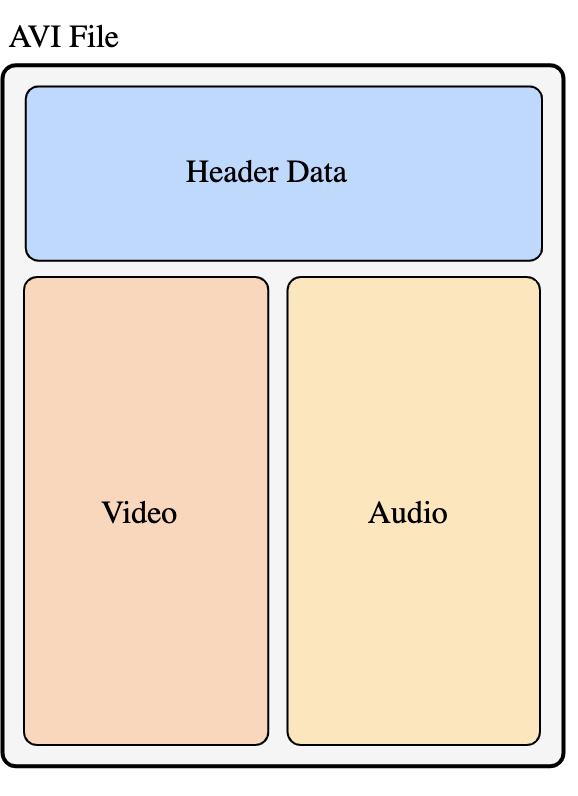
We will look at these concepts in a little more detail below.